Ask the internet how much you need for a first home and it hands you a percentage. Twenty percent. Ten. Three and a half. What it doesn't say is that the percentage is only the first of three numbers, and the other two are what catch people at the end.
Here's the full sum, on an example home, so you can see the shape of it.
What are the three numbers?
The down payment, the closing costs, and the cost of actually moving in. That's the whole list. Add them up and you have your summit, the amount you need in hand before you can stand in an empty living room that's yours.
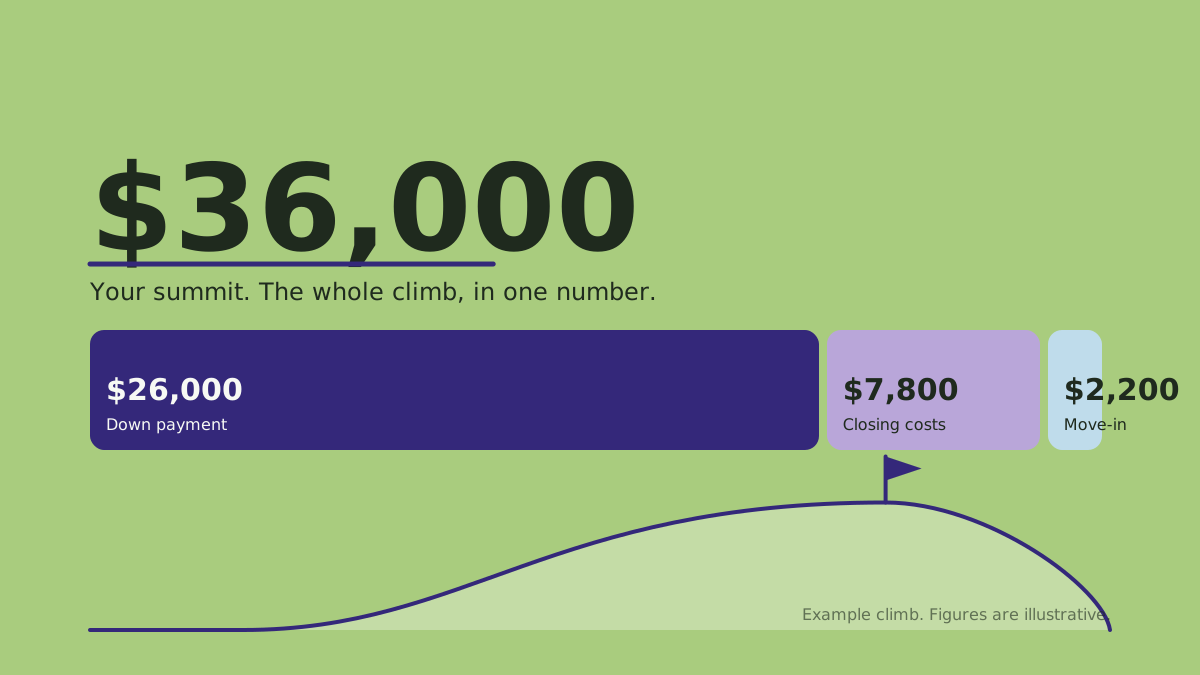
Take a $260,000 home as the example. Put 10 percent down and the down payment is $26,000. Closing costs, the fees and prepaid items that come due at signing, are often quoted as a small percentage of the price; the example member has budgeted 3 percent, which is $7,800. Moving in, with deposits, a truck, and the first round of things a rental never needed, comes to $2,200 in the example. Add them and you get $36,000.
That's the number. Not $26,000, which is what the percentage told you, and not “somewhere around forty,” which is what your gut said. Thirty six thousand, made of three parts you can each look at on its own.
Why does the percentage matter so much?
Because it's the biggest of the three and the only one you fully choose. On that same $260,000 home, 5 percent down is $13,000, and the summit becomes $13,000 plus $7,800 plus $2,200, which is $23,000. At 20 percent the down payment is $52,000 and the summit is $62,000. Same home, same closing costs, same moving truck, and the total nearly triples between the smallest and largest choices.
How much to put down shapes what comes after, including what you pay each month once you own the place, and that part isn't ours to advise on. What we can say is that the choice is yours to make with open eyes, and it's easier to make when the three numbers sit side by side than when a single percentage floats alone.
If you can't settle the percentage yet, don't. Run the sum twice, once at the lowest percentage you'd consider and once at the highest, and look at the gap between the two summits. On the example home that gap is $39,000, between $23,000 and $62,000, and seeing it written down usually does one of two things. Either it makes the lower percentage feel like the obvious place to start, with the option of putting down more if the saving goes well, or it makes the higher one feel worth the extra years. Both are fine answers. The one to avoid is the vague middle, where you're saving toward “about fifteen percent” and never quite know whether you've arrived.