Guide 05

Saving for a home with a partner without keeping score

One pot or two, equal split or proportional, and the three things to agree on before either of you logs a dollar.

6 minute read

Two people saving for one home is either the easiest version of this or the hardest, and the difference has less to do with income than with whether the two of you ever chose, out loud, how it would work. Most couples don't. They open an account with a hopeful name, each puts money in when they can, and the first real disagreement arrives eighteen months later as “I've been putting in more than you.”

Here are the choices, with the tradeoffs named, so you can make them on purpose.

One pot or two?

One pot means a single account that both of you feed and both can see. The upside is obvious: one number, one history, no reconciling. The downside is that it removes any sense of what each person contributed, which is fine for some couples and quietly corrosive for others, particularly when incomes differ.

Two pots means each of you saves in your own account toward the same summit. Each person owns their pace and their record, and there's a natural privacy to it. The cost is that the shared picture only exists if someone adds the two up, regularly, and tells the other. Two pots with no shared view is how you end up three months from a target with no idea whether you've reached it.

There's a middle path, and it's the one most couples drift toward: money stays where each person keeps it, but there's one shared record where every deposit from either person gets logged. The record is the pot. Where the cash sits is a detail.

Equal split or proportional?

Equal means you each put in the same amount. It's simple, it feels fair in the sense of identical, and it works when incomes are close. When they're not, equal means the lower earner is giving up a much larger share of their month than the higher earner, and that imbalance is felt even when it's never said.

Proportional means each person contributes the same share of their income. If one of you brings in 60 percent of the household's money, that person puts in 60 percent of the monthly amount. It's fairer in the sense of effort, and it requires one slightly awkward conversation about exactly what each of you earns.

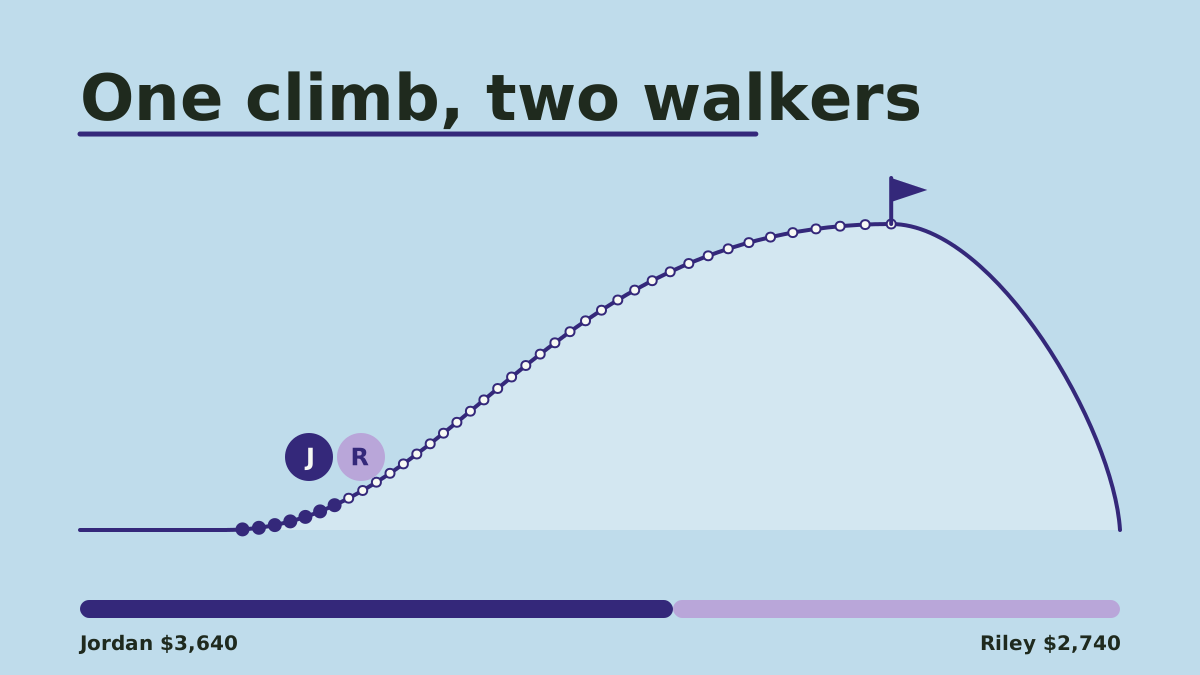
On the example climb, Jordan and Riley have logged $3,640 and $2,740 toward a $36,000 summit, and this month it was $500 and $350. That's not equal. It's around 57 and 43 percent, which might be proportional to their incomes or might just be what each of them could manage. The point is that both numbers are visible to both people, so whatever the split is, it isn't a secret.

A date that moves is a shared fact. A partner quietly covering the gap is a private debt.

Two walkers climbing the same ridge from two trailheads and meeting at the crest
Example climb. Figures are illustrative projections.
Two pairs of worn walking boots side by side on a dirt trail with the path rising ahead

Who logs what

Together $850 a month. Jordan 59 percent, Riley 41 percent. On the example climb that holds August 2029. Projection from your numbers.

Who keeps the record?

Someone will, whether you decide or not, and the person who keeps the record tends to become the person who feels responsible for the whole plan. That's a slow way to build resentment on both sides. The one who logs feels like the manager. The one who doesn't feels managed.

The fix is small: both of you log your own deposits, into the same climb, with your own name on each entry. The history then belongs to both of you, and a question like “where are we” has the same answer regardless of who asks it. It also means the next switchback, and the summit date, are shared facts rather than one person's report.

What do you agree on before the first deposit?

Three things, in one sitting, ideally with the numbers in front of you.

First, the summit. Home price, down payment percent, closing and move in costs, added up. Say the total out loud. A surprising number of couples have been saving toward two different numbers for a year.

Second, base camp. How many months of your combined expenses you want in a cushion before the switchbacks begin, and whose account it lives in. One to six months. Choose it together, because it's the part that will be tested.

Third, the split. Equal or proportional, and what happens in a month when one of you can't manage the usual amount. The honest answer is usually that the other person doesn't cover it, the deposit is logged as what it was, and the date moves. That's kinder than it sounds. A date that moves is a shared fact. A partner quietly covering the gap is a private debt.

What about disagreeing on the hill itself?

This one is common and rarely named: one of you wants the $300,000 home in two years and the other wants the $350,000 home in three. Neither is wrong. What ends the argument is arithmetic, not persuasion. Put both beside the current plan and look at what each asks of every month. On the example figures, the $300,000 home in two years needs about $1,451 a month from here; the $350,000 home in three needs about $1,148. Once the monthly ask is visible, most couples find the choice makes itself, because one of those numbers is a floor you can both hold and the other isn't.

On your climb

Hill Wallet Plus gives you a shared climb: one person invites the other by email, the co-buyer gets a free login, and both of you log deposits to the same hill with your own name on each entry, so who logged what is never a matter of memory. Saved routes let you put the $300,000 home beside the $350,000 one and see what each month needs. One Plus payment, $6 a month or $54 a year, covers both of you.

Join Our SMS List

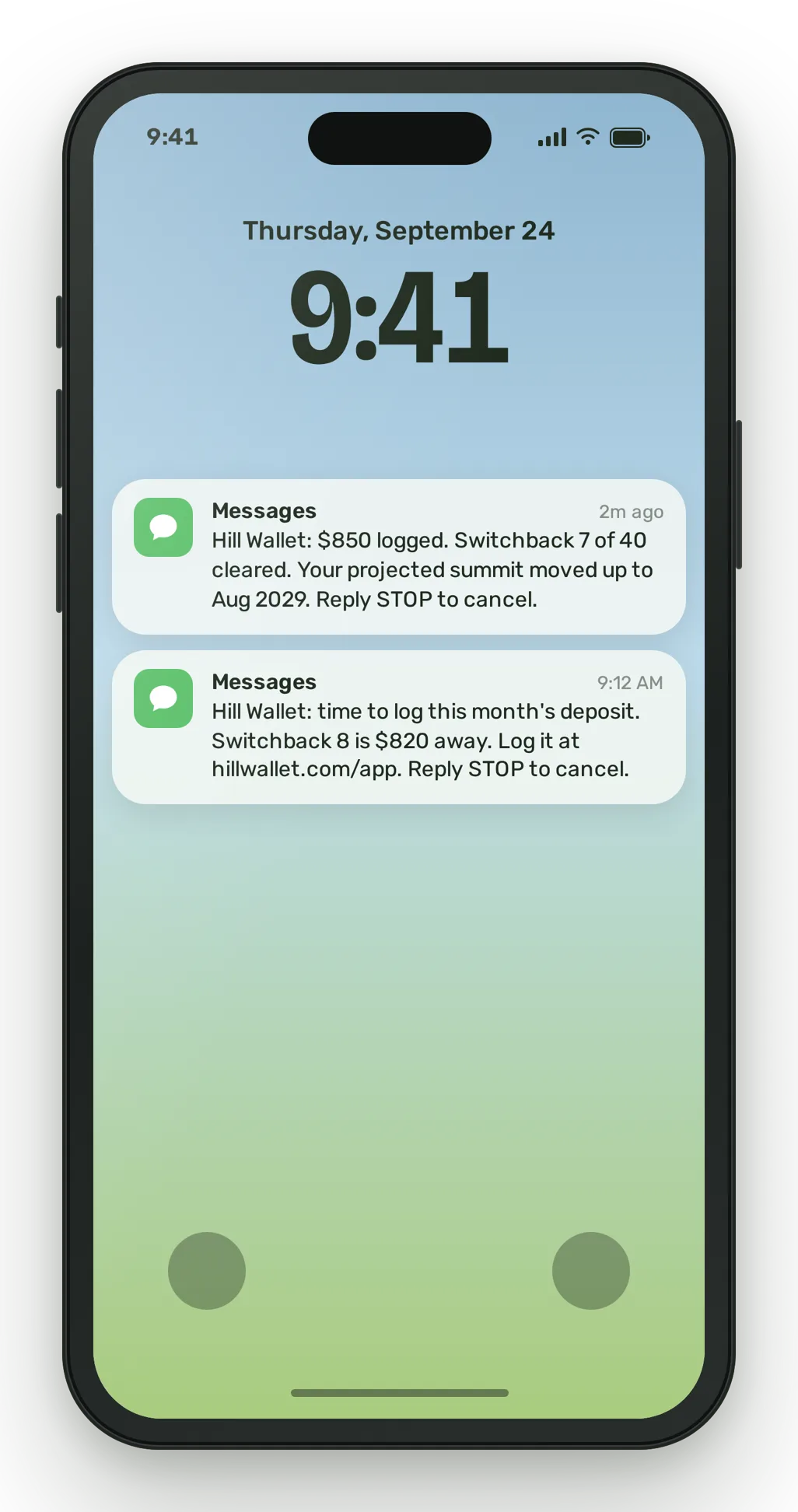
Climb Alerts are account notices, never ads. A reminder on the day you pick, a note when a switchback clears, your sign in code, a renewal notice. Nothing else, ever.

Your phone number is never sold, rented or shared for marketing. It is used only to send the Hill Wallet Climb Alerts you asked for.

A phone lock screen showing two text notifications from Hill Wallet: one saying $850 was logged and switchback 7 of 40 cleared, one reminding the member to log this month's deposit.
Two Climb Alerts on the example climb.